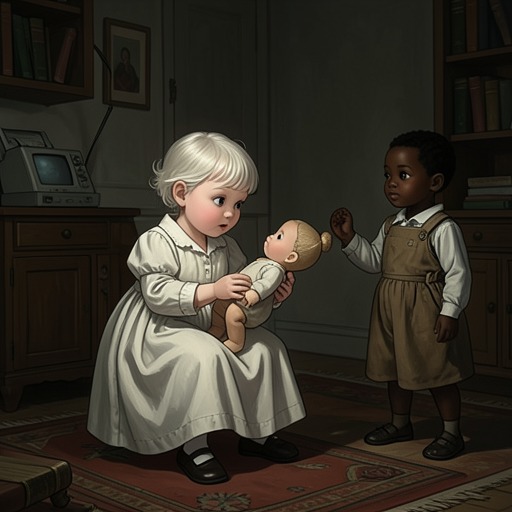
Soaphead Church and Pecola’s client-manipulator relationship
The Bluest EyeSoaphead Church and Pecola’s client-manipulator relationship is a brief encounter with lasting consequences: Pecola seeks a miracle that will make her beautiful, and Soaphead answers not with genuine help but with a staged test that exploits her trust. He presents himself as an instrument of the Lord, yet the episode reveals how his claimed compassion and his resentment of God become entangled in a deception that reinforces Pecola’s delusion of blue eyes.
The encounter and Pecola’s request
Late one hot afternoon, Soaphead is reflecting that the Maker should have sought his counsel when a knock interrupts him. At the door he finds a girl he does not know, about twelve years old, whom he regards as pitifully unattractive. She cannot initially explain what she wants; she holds something out to him, then tells him that she can no longer go to school and hopes he can help. When he asks what she means, she names her eyes and says she wants them blue.
The request strikes Soaphead as at once fantastical and logical: in his view, an ugly child is asking for beauty. He feels a surge of love and understanding, but it quickly gives way to anger. The shift matters to their relationship. Pecola approaches him in the hope that he can change her life; Soaphead’s response is shaped not only by what she asks but by his own grievance and judgment. Her vulnerability invites care, but it also gives him an occasion to cast himself as someone with special access to divine power.
A religious refusal that becomes a test
Soaphead initially tells Pecola that he can do nothing for her because he is not a magician and works only through the Lord. He describes himself as someone God sometimes uses to help people, and offers himself to God as an instrument. The refusal draws a boundary around his power even as it preserves the possibility that he can act on God’s behalf. For a child who has come asking for an impossible transformation, that distinction leaves room for hope rather than closing the request.
He then prepares a packet of food, sprinkling its contents with liquid from a small brown bottle. He places it partly open on the table and instructs Pecola to feed it to the creature sleeping on the porch, make sure it eats, and watch how it behaves. The instructions turn her request into an experiment whose result Soaphead has arranged in advance. Instead of telling her that he cannot give her blue eyes, he makes an animal’s response appear to carry a divine verdict.
Pecola follows the instruction. She sets the food on the porch floor near the sleeping dog’s nose; the smell rouses it, and it eats in three or four gulps. She strokes its head again. The dog looks up at her with soft, triangular eyes, then coughs like a phlegmy old man and gets to its feet. The scene gives her an observable event to interpret, but Soaphead has made the test deceptive: what happens to the dog is not a trustworthy revelation of God’s will. His power in the encounter lies in shaping what Pecola sees and in assigning religious meaning to it.
Mercy, deception, and the relationship’s consequence
In his later address to the Lord, Soaphead recalls the girl who came to him as someone who had found her way to him after being left alone. He presents himself as moved by her plight and contrasts his supposed mercy with money and deserved reward. He also insists that he did not touch her, and claims that he changed her eyes because God had forgotten how to be God. His account frames the intervention as compassion, but it is Soaphead himself who has supplied the poisoned food and constructed the apparent test.
That contradiction defines the relationship. Soaphead can imagine himself as a merciful rescuer while deceiving the child who has trusted him. His anger at God does not lead him to give Pecola the transformation she seeks; instead, he uses her request to enact his own judgment about divine failure. The claimed miracle is false, and the distinction between spiritual help and manipulation collapses under the practical consequence of his scheme.
Pecola’s belief that she has blue eyes is not corrected by their encounter. The dog’s behavior and Soaphead’s account offer her a framework for believing that her wish has been granted, while the actual circumstances leave her unchanged. Their meeting thus intensifies the delusion rather than relieving the despair behind it. The relationship is unequal from the start: Pecola arrives as a child seeking help, while Soaphead controls the test, its interpretation, and the story he later tells about his motives.
Significance
The episode joins Pecola’s longing for blue eyes to a counterfeit religious authority. Soaphead’s language of service to the Lord gives the deception a sacred appearance, but his instructions make him responsible for the outcome he encourages Pecola to interpret. The encounter exposes the danger in a form of care that centers the supposed benefactor’s self-image rather than the child’s actual need.
Its final irony is that Soaphead calls his action mercy and presents himself as having answered Pecola’s wish, while the encounter can only sustain her belief in a transformation that has not occurred. He claims to have intervened because God failed her, yet he offers no protection from the conditions that made her ask for blue eyes in the first place. His false miracle becomes another betrayal within Pecola’s isolation: the promise of help is real to her, but the help itself is not.